

Interview & Photography by John Russo
JR: Your new work, Block Chain and Shackle, immediately suggests ideas of connection, constraint and perhaps systems of power. What was the initial spark, and what did you want the title to activate in the viewer’s mind?
PC: The work goes back to my collaboration with For Freedoms, the artist-led civic platform. I had been working with images of the Statue of Liberty, and I shared them with a dear friend, Hank Willis Thomas, one of the founders of For Freedoms. Hank said to me, “You know, Paula, the Statue doesn’t mean the same thing to me that it does to you, because my ancestors came here against their will.” I was humbled, and my mind was spinning.
Then I started looking at the broken chain and shackle at Liberty’s feet and researched their history. I asked Hank whether knowing about them would change how he saw the statue. When we sat down together recently in Madrid, he told me, “Paula, you’ve changed how I see the statue.” We are now collaborating on the project. So, the heart of the work is revealing a history that is true but has been hidden from view.
As for the title, “Block Chain” relates to the technology of creating a digital record and authenticity. But it’s also literal: the chains are blocked from our view. The title holds both ideas, a chain we’re blocked from seeing and a system that blocks us out.
JR: You often move between very different materials and technologies. What does the material language of Block Chain and Shackle allow you to say that another medium could not?
PC: I continue to search for what material will best manifest the artistic concept. I’ve been talking with a fabricator in China about metals, perhaps bronze, perhaps silver, and the scale needs to be monumental. For the first iteration, I worked with Braden Weeks-Earp, a wonderfully talented architect and artist in composite wood, gessoed in white. I wanted to mock-up physical objects to which to respond.
There’s something ghostly about the forms being white. The forms carry complexity: an open shackle is also two semi-circles that form an embrace. At a scale of, say eight feet tall, it would be disorienting. The form that invites you to be held is also a form that would constrain you against your will. I appreciate the duality, that an object can mean more than one thing simultaneously. So, stand by on material. If I can realize it in metal at a larger scale in time for Intersect Palm Springs, I will. It’s still unfolding. It hasn’t found its full expressive potential yet.
JR: The word chain can suggest both connection and restriction. Does the work ultimately feel more like a meditation on freedom, dependence, or something in between?
PC: These are really good questions and so thoughtful. I’d say it’s a meditation on freedom, and on the truth of inclusiveness in a democracy. As Hank puts it, this statue embodies promises of Liberty while acknowledging the darkness in our past. It’s about abolition, and the torch lighting the way forward.
To use your words, I think of it more as connecting and that all immigrants belong. At the same time, there are restrictions. It’s simply a fact that you can’t see the chains. In early designs, Liberty held broken chains in her left hand; they ended up at her feet, where they’re nearly hidden. The original idea has been edited. I am going to walk to the top of the statue again in October. I’m told that even from the crown you can’t get a view of the chains or shackles.
There are contemporary pressures on our democracy: including restrictions on voting rights, mail-in ballots and on women’s health. So the work is also a comment on constraints that are still with us. The promises of Liberty have yet to be fulfilled. If the chains weren’t there, we might tell ourselves we’d moved on. But they are there. We must be vigilant to preserve our democracy.
One more thought on block chain, which may be a tangent: it’s built on connection, a series of linked transactions, but it’s also closed. You can’t see in. That kind of opacity is costly to our freedom.
JR: How does Block Chain and Shackle fit into the larger evolution of your practice?
PC: It underscores something that runs through everything I do: I’m an acute observer. Details are worth of attention. Whether a torn piece of paper, or a crushed Solo cup. In some of the recent digital works you saw, I simply highlighted the beauty of a grandmother and granddaughter on the beach, a child wearing water wings, and the color of a life preserver. I get to share my experience with viewers and to remind them that moments of presence are truly enriching. They help us know ourselves, and to recognize that the sacred ground is beneath our feet, not on a screen.
JR: Did this process take you somewhere unexpected?
PC: Yes. I learned so much more about Emma Lazarus, who wrote “The New Colossus,” the poem we all know (“Give me your tired, your poor, /Your huddled masses yearning to breathe free.”) She was an accomplished poet, an American of Jewish descent, and an advocate for immigrants. She was asked to contribute a poem to raise money for Richard Morris Hunt’s pedestal upon which the statue would be placed. The French paid for the statue; Americans raised the money for the pedestal. It may have been the first example of crowd source funding. She wrote it in 1883 and when the statue was dedicated in 1886, she wasn’t acknowledged. Her poem wasn’t added to the pedestal until 1903, on a bronze plaque, years after her death. To this day, the poem is inside the pedestal.
I’ve also been thinking more about handwriting and mark-making. I found a copy of her original manuscript and copied her writing. It was a way to relate to her, kinesthetically. How did she form the letters? Was that hyphen intentional? It became a moment of respect for what this woman gave our country. So that’s what I learned: to return to the original mark. There’s something revelatory there.
JR: Let’s pivot to The Reverse Side, built around the idea that the reverse side also has a reverse side. What drew you to that Japanese epigram, and how did a philosophical idea become an object that can be seen, touched and heard?
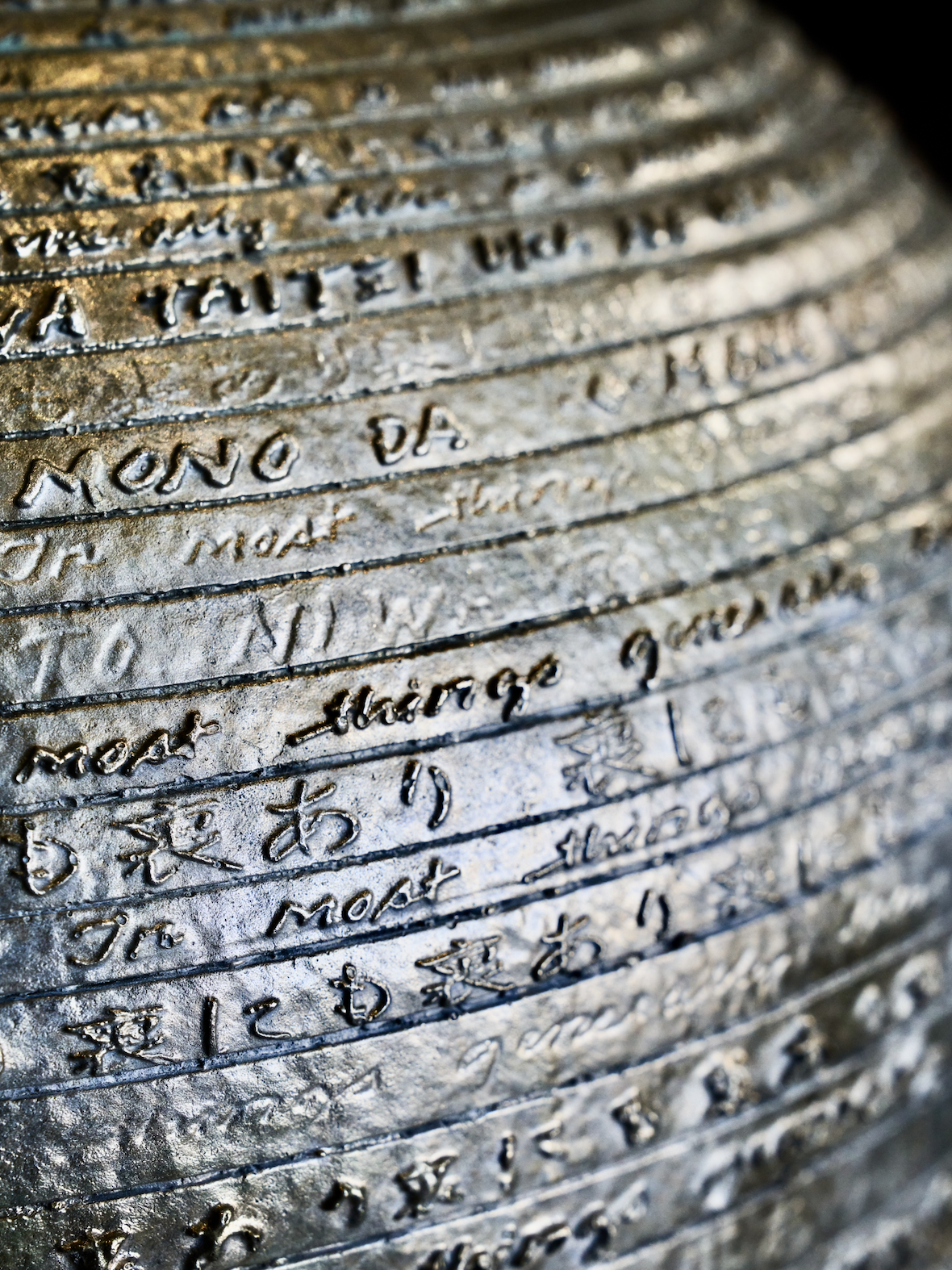
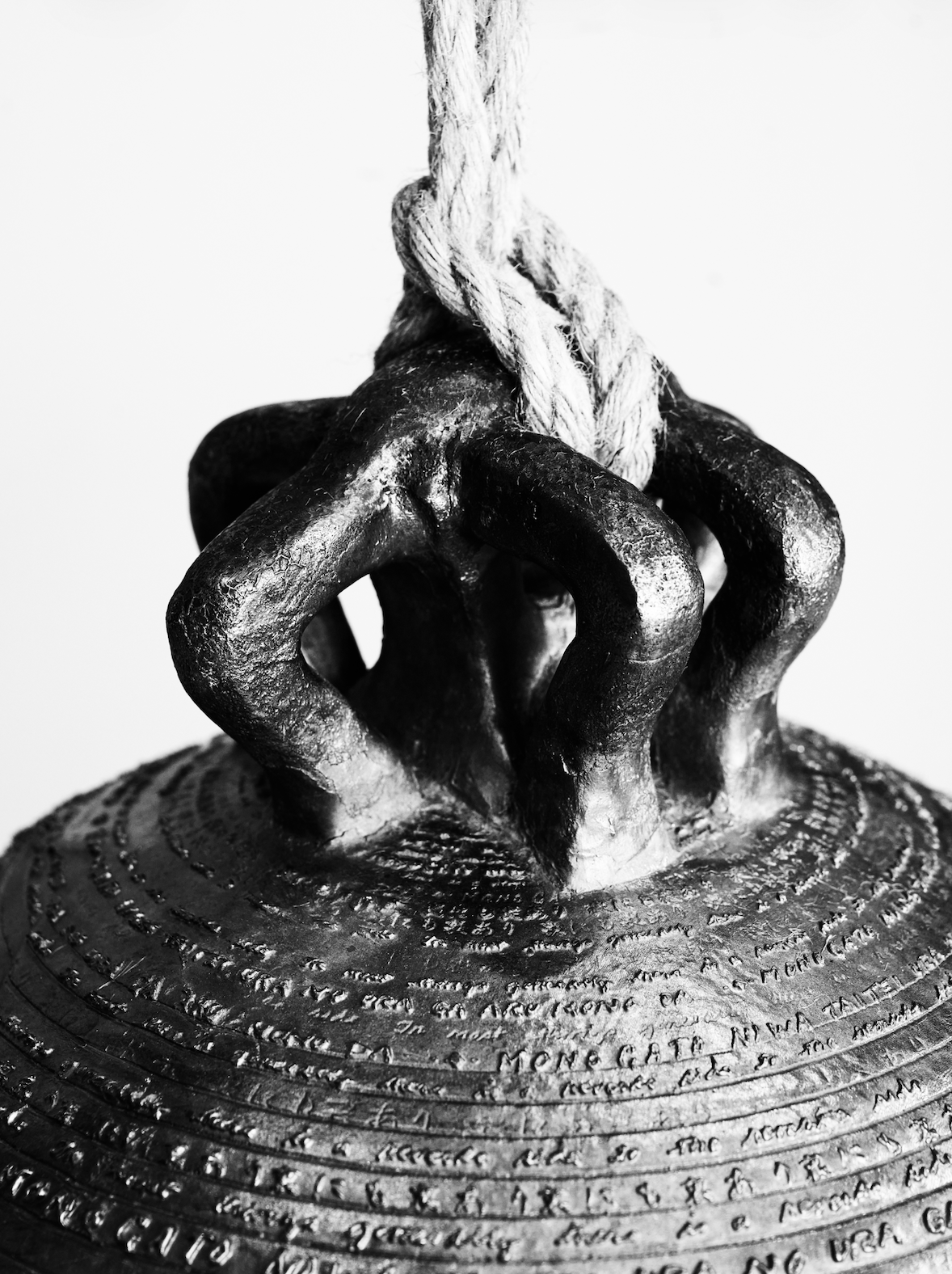
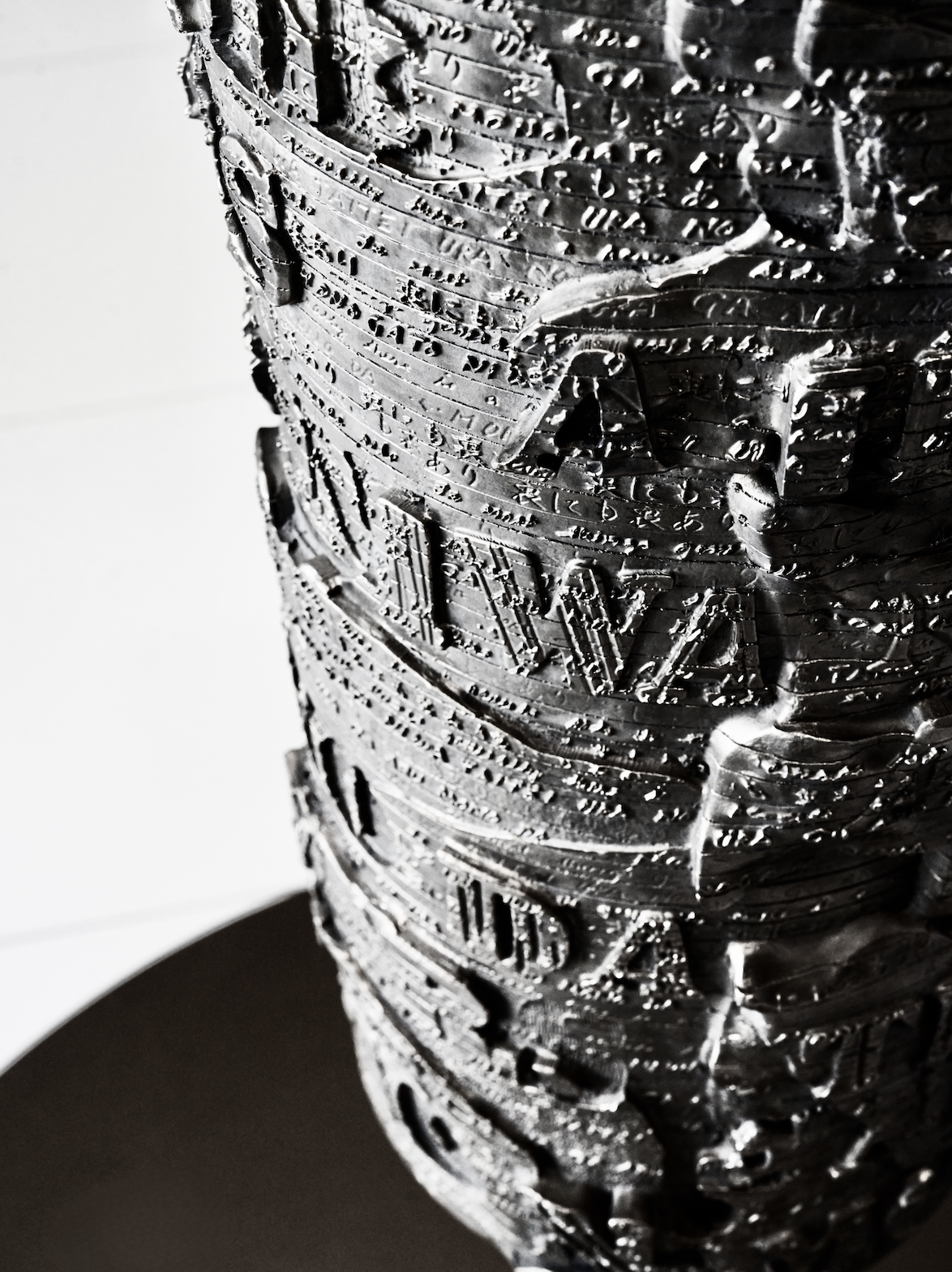
PC: I came across the epigram eight or ten years ago, and it kept arising in my consciousness. I made prints of it, drawings, and paintings. When the bell commission came along, I thought, what a wonderful, physical expression of this phrase. I literally took a flat sheet of paper and rolled it into a cylinder, like an Asian temple bell.
At first, I thought about notions of yin and yang, and about polar opposites. The phrase offered a fresh take on the cyclical nature of things, and on how, when we see from only one side, so much stays hidden. With the bell, much of the information is literally inside it and revealed only when people ring it. So for me it is a hopeful message of empathy.
Life is more expansive when I listen and learn from others. I had the chance to study the Japanese characters and understand the phrase more deeply.
JR: The history behind the bell is particularly powerful: the destruction of bells during World War II and the effort to preserve the tradition of the London Bell Foundry. How much did that history shape the work?
PC: First, working in bronze was remarkable. I was one of three artists commissioned to make a series of four bells: the artists were able to keep one and the three others were sold to benefit the London Bell Foundry.
It was meaningful to me, because the Liberty Bell was cast in London, at Whitechapel. So again there was a connective chain, if you will. It was a eureka moment and a way to honor the Liberty Bell and America’s 250th birthday.
I was able to work in bronze, an ancient material more than five thousand years old that changed civilization. Bronze is a blend of copper and tin enabling the manufacturing of weapons and architecture. It’s kind of magic: adding two things together to make something transformative. The era lasted for two thousand years. I am reading Eric Cline’s 1177 B.C., about the collapse of the Bronze Age, and unfortunately there are many parallels to our own turbulent times: a major shift in climate, droughts, the unraveling of global alliances and trade routes. That became a secondary fascination. But the first was understanding how exceptional bronze is as a material and how it has a life of its own.
JR: Both works seem interested in things that are more complicated beneath their surface. What do you hope viewers discover if they spend more time with your work?
PC: With Block Chain and Shackle, I hope viewers will learn that there are broken shackles and chains at the base of the Statue of Liberty and will inquire why we don’t know about this intentional part of history. It’s a part of our history that should be obvious, and it’s about belonging, not otherness. I also think the forms have a lot of potential, especially at different scales and as they become more abstract. I’m excited to see where that goes.
It’s like The Solo Cup Project. I can’t tell you how many photos of solo cups people send me, and I just smile. I don’t really need to see the solo cup in someone’s parking space. But the idea that someone noticed a piece of plastic they should pick up, and that it was formed by someone and carries a mark is notable.
As for The Reverse Side Bell, my research led to Hitler’s bell cemeteries. In occupied Europe, Hitler directed Herman Göring to seize roughly 175,000 bells. Hitler understood that bells served as vital channels of communication and connection. There are photographs of bell cemeteries, where they sat rendered voiceless. The bell is a reminder: use your voice. I love watching viewers ring it. They ask, “How do I swing this hammer?” And I say you know how. You know how to use your voice. The reverberation and the joy of it: I feel I’m helping people connect with, their whole being, through sound.
I love these questions.
JR: I love your answers. I’m very interested in large-scale outdoor sculpture, and it got me thinking about Block Chain and Shackle in weathering steel, which breaks down over time into a beautiful rust color. Had you thought about Corten?
PC: Yes. Now we’re into an immersive studio discussion about ideas, which is really fun. We’re in our zone. The statue was originally copper, bright and shiny, and over time it weathered to a verdigris patina. My question is whether using the same is too didactic. There is less room for viewer interpretation. John, you do that so well with your photographs. You respect the viewer. You offer the mood, the feeling, the smile, the smirk, and you never tell viewers how it’s supposed to be: You create an image that embodies a person’s being.
JR: One hundred percent.
PC: There’s another level of dimensionality: you work in two dimensions, but it all makes sense once you see it in three. It’s a different feeling. I had the same feeling working with Factum Arte in Madrid, founded by Adam Lowe. Translating an idea into form is such a joy. And it takes courage, right? And trusted support. You want people around you who say, yes, go explore.
JR: Just do it and explore.
PC: That’s how we learn.
To learn more about Paula Crown follow her @paulacrownart