
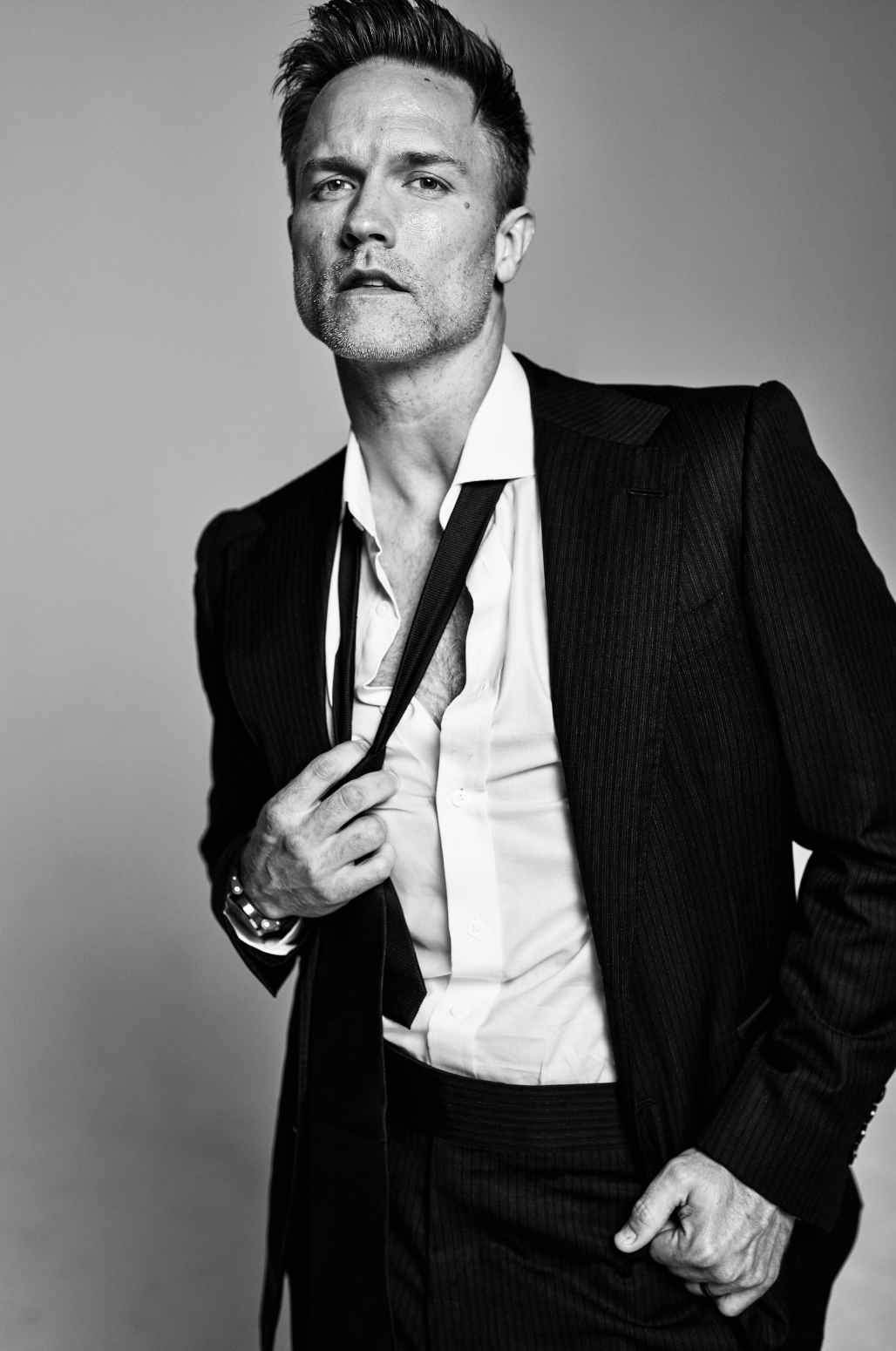
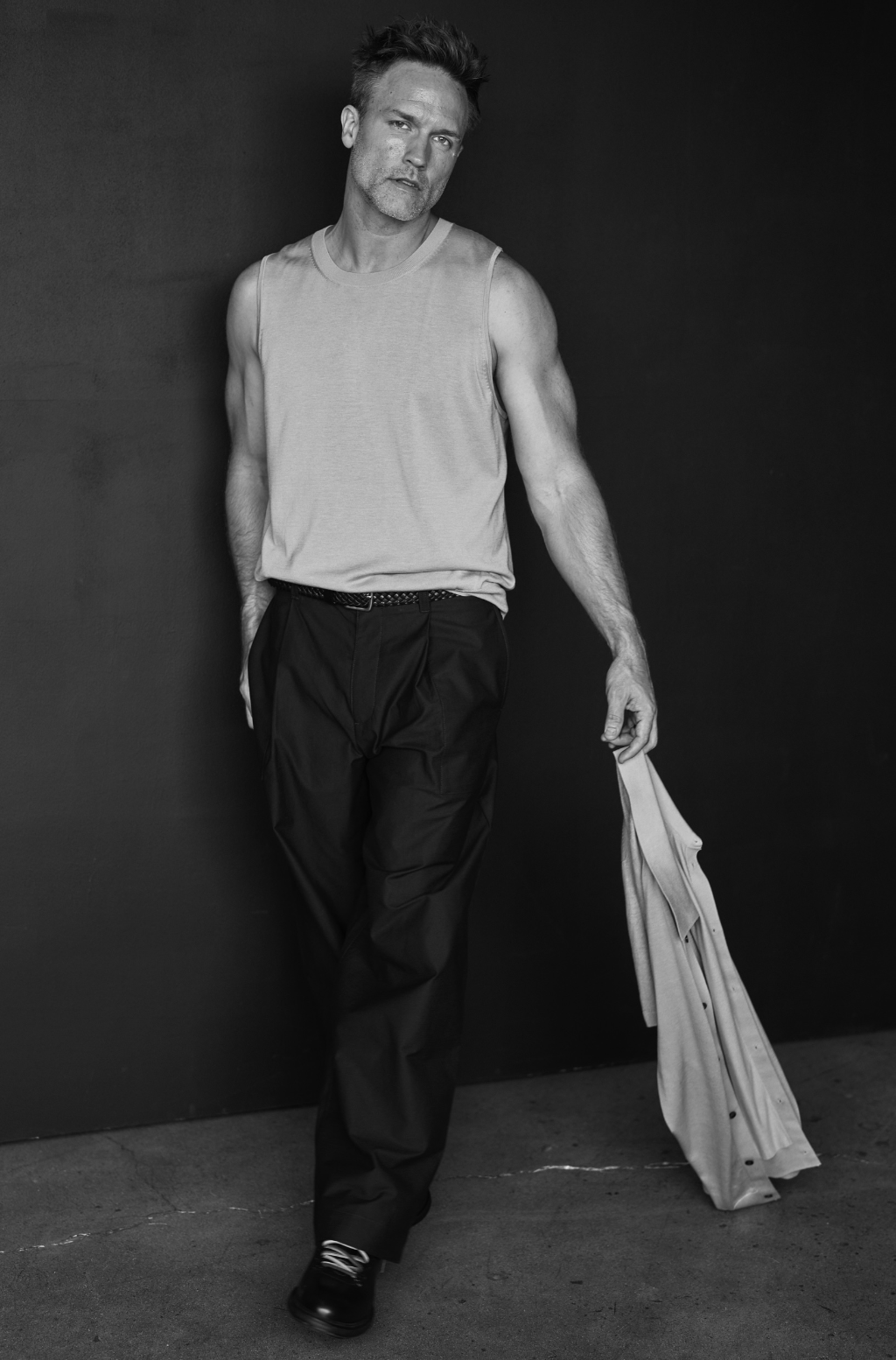
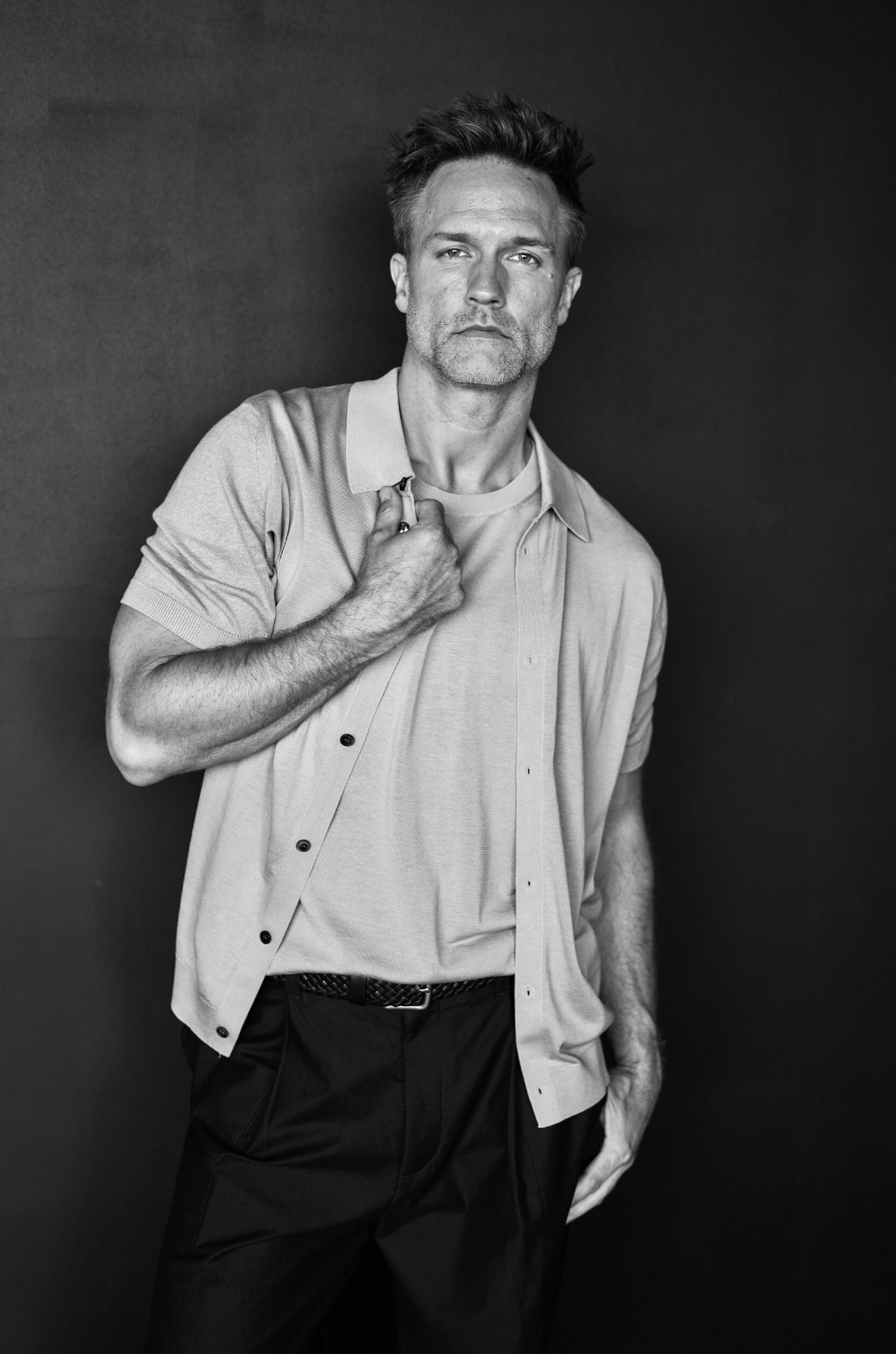
S C O T T P O R T E R
Photographes: The Riker Bros.
TM: Season 3 of Ginny & Georgia had so much anticipation around it. How would you describe Mayor Paul Randolph’s evolution this season, and how does his relationship with Georgia challenge or surprise him?
SP: The fraying of Paul’s trust in Georgia drove so much of his emotional journey this season. To him a marriage was supposed to be built on trust, and he found their foundation was actually riddled with lies. Throughout the season you see Paul start to question everything around him, to falter on his decision making, and to ultimately react in ways that felt somewhat out of character. I wouldn’t say the Paul evolved as much as possibly devolved. As so much around him crumbled he did as well, as the lies piled up and the adversity increased, he reacted in darker ways. I think the pressure of the standard Paul, and others, hold him to finally started to crack his exterior and I’m not sure he was prepared for that. The final lie from Georgia broke him, and while I think his decision to finally leave and protect himself was correct, the actions he took were not. Paul is down in the dirt now, and he has to find a way to pick himself up and find atonement.
TM: The show has become known for its mix of dark humor, heart, and social commentary. What do you think makes Ginny & Georgia resonate so deeply with audiences, and how has it evolved since you first joined the cast?
SP: I don’t think our show shies away from anything. All conversations are welcome. All issues worth exploring. I think we connect with a lot of folks from different walks of life with that. Human beings are deep and complex beasts and rarely stay in a static state through hard times or the best of times. Flashes of light in the dark, moments of laughter in tough times. Small moments of pain or regret or deep sadness in the happiest of seasons. That’s real. Our show seems to really get that. I don’t know how the writers repeatedly build those moments into our scripts but they have become a true hallmark of our show. “Ginny & Georgia” could be dropping the heaviest scene in the world on us and have us crack up in the middle of it. A great example was Paul’s heart to heart with Zion, asking if Georgia was truly capable of killing a man, when out of nowhere he just yells the line, “She doesn’t even like Cynthia”…the levity breaks through a very heavy scene and helps as a reset for Paul and the audience. I think folks really enjoy that roller coaster ride of emotions scene to scene.
TM: You’ve had incredible chemistry with Brianne Howey onscreen. What’s been most rewarding about collaborating with her and the rest of the cast this season?
SP: Brianne and I worked together before “Ginny and Georgia” on an episode of “Hart of Dixie” and found out we work well together way back then. Our styles and approaches mesh nicely. We have built up an incredible well of trust in each other over the first few seasons. We’ve been asked to do a lot, and I always know she will have my back and she knows I will always have hers. That allows you a freedom in scenes to explore, experiment, and truly build a relationship between characters that creates a grounded and honest space. It helps that she is tremendously talented, of course. Haha. But that same thing can be said for all of our cast. I watch this show as a true fan at home with my wife. We are consistently blown away by the varied performances given by all the actors on this show. I believe this whole cast will be working for a very long time, and that’s a true testament to all of their talents.
TM: The show balances small-town charm with emotional intensity. How do you prepare for those heavier or more intimate scenes while maintaining Paul’s composed exterior?
SP: I know more about Paul than we’ve ever explored on screen. Through deep conversations with Sarah Lampert and Deb Fisher over seasons 1 and 2 we really built him out, explored his history with his family, school, his travels, and more. Wellsbury got similar treatment. It’s as much a character as we are, and if Paul is the mayor, it was vitally important to understand the people who live in a place like Wellsbury, the general attitude and goals of those within its town limits. Once those parameters fall into place it’s much easier to honestly lean into any scene, regardless of the emotion. You can ground the silliness of a costume party or fall festival or the drama of an all-enveloping court case as it swirls around you like a tornado equally when you have a true understanding of the characters and location. It was fun to build that history and it continues to be a blast seeing how Paul and Wellsbury evolve with the show with our current creative team.
TM: You’ve played such a range of characters, from Friday Night Lights and Hart of Dixie to Ginny & Georgia. How do you choose roles that still challenge you creatively after so many years in the industry?
SP: Man, I’m so lucky. Honestly. I just want to tell great stories. And there are so many great stories out there to tell. I’m just fortunate that storytellers have seen me, over time, as an actor that may offer something to their tales. To have had the opportunity to play such varied characters, Jason Street, George Tucker, Paul Randolph, just means the world to me. And they are almost all roles I had to battle for, audition for, which makes me even more proud in a way. They were scripts that I read that really tickled me in some way, impressed me, made me want to fight to be a part of them. The same with roles that have had less fanfare. I fought for the role of “Orson” in a show called “Up Here” fiercely because he was a character I had never really read before. It was in a musical comedy, a place where a lot of folks wouldn’t expect to see me, and it was a huge challenge. At the end of the day, I don’t really get to choose, that’s up to the creators and networks. What I get is the chance to try and show I could bring something to these characters and hope that the storytellers agree. I know how fortunate I am to have that chance, and I’m so grateful for that chance every time.
TM: Fans of Friday Night Lights and Hart of Dixie still adore those shows. What do you think makes those stories – and your characters in them – so enduring in pop culture?
SP: I’d say community. These shows are so different from each other, and I’m throwing “Ginny and Georgia” in here as well, but they all share a common heart. With Dillon, Bluebell, and Wellsbury, community is at the core of each of them when you get down to it. And that core concept builds fan bases that grow together, that truly gel into their own little collective. You never truly know what shows are going to get that reaction. I’m not sure any of us thought that FNL, HoD, or GnG would have had the staying power they have, and so much of that is a testament to the fans. It’s so incredible to watch those audiences grow, so special to be a part of it. I’ll never not appreciate them.
TM: You’ve moved seamlessly between network television, streaming series, and even voice acting for major gaming franchises. How do you see the evolution of storytelling across these different mediums?
SP: I approach all of them the same way. Whether it’s a football player or a mayor, a norse god or a universe hopping superhero, I just try to find the core humanity in each character. That allows them to thrive in all these different situations. Allows them to be believed, hopefully. As far as different mediums go, stories have been shared in so many different ways over generations and I think the most impactful ones have always had that same approach. Finding the honesty and humanity, no matter the genre. Through written word to stage to cinemas and television, it’s always been that way. I hope, as we continue forward, we continue to value the human element as much as possible.
TM: You’ve been open about fatherhood and balancing your career with family life. How does being a parent influence the roles you take, or the stories you want to tell
SP: My family is everything to me. I’m a working father. Just like my parents. They instilled a work ethic in me that I hope reflects them. I just want to continue to work. To honor them. Through all of that I hope I can honor my wife and children as well. I hope they can see the work that goes into this and some of their grandparents rub off on them, no matter what they choose to do in life. When I’m on a production it’s long hours and they understand it’s what my career calls for, but when I’m off they really feel my presence at home and that’s the absolute best. It’s all a balance. When I’m not shooting I’m still busting my butt to be ready for the next possibility, the next job. And they see that as well. As far as what roles I take on, only on rare occasions has it affected my decision making. It usually has to do with time away. I’ve been very fortunate to have shot a lot of projects where I get to take them with me. They’ve spent summers in Harlem, Toronto, and the farmland of Connecticut with me and we’ve had such a blast on the road together. I’m not so sure they’ll ever want to watch anything with their old man in it, but if they ever do we will just make sure it’s age appropriate for them. For that reason, fatherhood doesn’t usually govern what stories I choose to jump into. I have shied away from truly dark stories, so maybe it plays a part there.
TM: Looking ahead, is there a dream project, genre, or creative challenge you haven’t tackled yet but would love to explore next?
SP: Honestly, there are too many to count. I’m a huge nerd so of course superheroes, soldiers, mysteries, and big crazy sci-fi are up there. But there are also so many creative minds I would love to work with and learn from, no matter what the genre. All I can do is continue to grind, appreciate what I’ve done so far, and be ready for whatever is next.